
Summary (because this article ended up becoming 5000 words with a 28 minute read time)
I used to think mining was something to keep away from, until my wife began to work in the sector. Turns out, it’s not drab and dull, and in fact its importance to the progress of civilization is too understated. I try to explain my understanding of how the mining world is shifting owing to adoption of new technologies, the global shift to greener tech and AI presenting dual demand shocks for energy and REEs, the micro and macro-economic implications, and the geopolitical Jenga we’re playing.
As mining picks up shiny modern tools while looking to retire the the rusty pickaxes, I describe gaps I see in some implementations of those technologies. I worry about the pace of progress and if it can keep up with the pressures that private industry, especially Big Tech will exert as the economic forces move the world into competition in scarcity.
I then explore a make-believe scenario where mining incumbents have no option but to either become technology players themselves, or bend the knee to Big Tech Companies that may decide to take matters in their own hands.
Either way, the Information Age in the mining sector is inevitable irrespective of who owns it, and IT capabilities will be the most important for individuals and companies – a place where I’m very happy and capable to participate and to help this sector, and in the process help humanity reach its next frontiers. First principles thinking – I want to be early to the table where the revolution is going to happen, be party to the outsized returns before the mainstream taps into it, and hopefully be proud at my deathbed of having influenced the way humanity built the next blocks of its progress.
Let me start by addressing one thing right off-the-bat. This is not one of those contrarian arguments that I make to grab attention. This is an opinion that developed from one end of the spectrum to the exact opposite end as I learnt new information, made sense of the world around me, and let my brain run wild while connecting the dots and attempt to peek at the future.
First off…
What is a thoroughbred techie doing advocating for mining, when AI is the talk of every town. What makes me think that the real pot-of-gold at the end-of-the-rainbow lies in mining? Especially when mining (and oil et al) is the ONE sector we all techies love(d) to dunk on.
The dirty, evil, unsexy sector that most of us tech-natives would not touch with a 10-feet pole wrapped in lead while wearing two PPE-suits.
Now that the visceral analogy of what I used to think about the sector is out of my mind and on to my screen, let’s unpack how the current opinion took shape.
The story begins with my wife starting her second career innings as a management consultant with an organisation that has (almost) exclusively mining clients after shutting our bakery and gifting startup. She had a couple of other options and frankly, I had vehemently tried to convince her to consider the other options rather than build her career in something that touched mining. She did choose the mining option, and I supported her in that choice, although a bit skeptically.
Being married to someone who is actively involved in the scene, and being a collateral consumer to some of her learning and conversations over time has changed my perception. Add to that, Tech has taken a turn that I feel less excited about.
Welcome to my rant. Silicon Valley, I’m sorry for what I’m about to hurl at you. Mining, you’re welcome!
Mining is still kind of unattractive, but the opportunity to participate in its evolution is something I cannot let ignore. And it might just be the most important problem to solve in the next decades.
Even more important than building the next software-abstraction built on top of another abstraction, aimed at capturing the FOMO-led venture capital funding cycling from one over-funded bloat of a company to a 13-people startup that claims to be 30 years ahead in technology than they actually are. (surprisingly amusing but accurate definition of what’s been happening in the valley)
Mining has been the bedrock of civilisations since the dawn of humanity. EVERY civilisation that flourished and hit a zenith did so based on what it could extract from the earth and how much it could extract. The Bronze Age was literally defined by copper and tin mining. Rome’s wealth was built on Spanish silver and North African minerals. The British Empire industrialized through coal, steel, and iron ore fuelling railways, ships, and colonies. The California and Australian gold rushes triggered global migrations, new cities, even new nations. I’m no history buff, I googled all of that, but what I realized in the process is what’s important. Mining is the upstream of everything.
Let’s go first-principles, What’s a simple way to spot high-leverage industries?
Find the one that enables all the others.
Mining is the upstream of every major trend:
- AI? Needs chips. Chips need rare earths, silicon, tungsten, copper.
- EVs? Require lithium, cobalt, graphite, nickel.
- Solar, wind, hydrogen, nuclear? Every single green energy source depends on mined inputs.
- Defense, aerospace, satellites? Same story. Titanium, aluminum, carbon composites
- Infrastructure for climate adaptation? Reinforced concrete, high-performance alloys, thermal insulation, ceramic composites.
All mined.
The Geopolitical Jenga of the 21st Century
If you follow the news – we’re on the precipice of more conflicts over Rare Earth Elements (REEs) critical for the Green Energy Transition as well as the massive needs for compute, energy and resources that the AI race asks upon us.
Trade wars almost at the verge of the Cold War are ON right now if you start peeling the layers of Why in the world you can no longer buy Huawei Phones in the US, or why NVIDIA/AMD have to develop special DD/GRE edition GPUs specifically for the Chinese markets, or why Taiwan lives in continuous fear of being taken over by China, or why the USA is protecting Taiwan like its own baby that holds an expensive toy called TSMC, or why select countries in Africa and South East Asia are in the middle of a tussle between India and China’s soft power draws building infrastructure and ports. And don’t even get me started about the tariff hot-potato that the US and China have been playing, with China slyly also restricting the flow of REEs that would leave OPEC teary eyed about a time when they used to hold the world ransom with oil.
If the last paragraph was too much for you, let me give you the tl;dr –
The tech world and the mining world are colliding with each other; and countries that hold access to (plus the countries that aspire to access) the next-generation enabling materials of the technology (that’s about to explode in demand) are fighting using our old friend economics.
That looks beyond our locus of control doesn’t it? Yes, but here’s the opportunity for arbitrage especially for tech talent
The Economics of What’s happening and what it could lead to
Let’s jump back to Grade XI Economics. I know it’s going to get boring, so I’ll give a tl;dr at the end of this section. Feel free to skip!
Demand and Supply together determine Price at a point called equilibrium. This Equilibrium gets disturbed every time there’s a movement along the demand or supply curves. Price remains in check as long as demand and supply can meet at a point.
More Demand / Less Supply means – Prices go Twinkle-Twinkle Little Star (up above the world so high)
Less Demand / Extra Supply means – Prices go Humpty-Dumpty (have a great fall)
Corny jokes because I’m just trying to make sure you don’t fall asleep.
So, the world events are conspiring towards a situation where the demand from Tech is outstripping the available supply AND at the same time Geopolitics Players are also looking to restrict the supply of the materials we need for the next generation.
So, the Price movement for materials (and energy) is not only going UP but it can go up at a rate that’s non-linear (even more than what we can see now)
What happens when your buyer can’t get enough of what they want at a price they are willing to pay? They either flesh out more money to outstrip the other buyers or they substitute.
That was the lesson in Micro-economics, now comes the elder brother Macro-economics.
Over-simplifying the concept of a GDP (same principle for a company) is the sum of all things sold times the price you sold them at.
So, Countries that hoard energy & materials can just sell the same stuff at a higher rate and enjoy a higher GDP, and Companies in mining can benefit through the same mechanisms.
So, mining companies actually benefit if they remain lazy-assed and continue to mine inefficiently?
Not really because the invisible hand of economics brings in the threat of substitution. Both in terms of a different supplier or an entirely different solution that renders the need obsolete. Think of the dominance of Li-ion/NMC batteries right now, and what happens if the fun people working on Sodium based batteries manage to improve the product. You could be sitting on a pile of something that was valuable once but now isn’t. Aluminium is a great example of going from being more valuable than gold to being used in your diet soda can.
That brings our whiteboarding exercise to a shorter context and a smaller window of playing the “price is right”. The minerals causing the world to aim guns at each other right now and just slightly short of launching missiles might not even be worth it half a century later. But they are critical now, and there are buyers. So there IS a peak price everyone will try exploit.
The promised tl;dr
I explained economic mechanisms badly with a couple of stupid jokes and tried to establish why some minerals/materials are sources of value that need to be unlocked – at the right times and right prices.
I feel like the world jumped a step when it ran to build AI and Clean energy dependent on mining REEs, and call it the 4th Industrial Revolution without first solving for our ability to extract (or obtain) what we can, how much we can, and how well we can (on a number of factors). And that can upset the balance of the world and create a ticking time bomb situation
The Mining Sector Situation
Let me jump back to my original hesitation of why I wanted my wife to avoid mining industry.
I thought it was dirty both figuratively and morally, it was slow to innovate and adopt (what would a consultant even do if a client was just going to not act on any world changing ideas presented to them), and kind of an industry where outsized returns weren’t as likely as the ceiling-agnostic returns we’ve seen in the valley.
And bit-by-bit, those notions have been chipped away and made me more optimistic about the mining world. And from that optimism, to now being excited about the possibilities that this act of extracting from the Earth (and even oceans, moon and asteroids apparently) holds.
I have come to learn that mining sector is eager to adopt new technologies, break some of its older patterns and step into the modern world.
It’s just kind of too large, to react with the swiftness of a break-first and learn-later mindset, also because for them the stakes can be higher. A bug on an Instagram feed is okay, lives lost because an implementation of not-yet-ready technology is not.
What I feel is lacking is a participation from some of the best problem-solving minds and mindsets that humanity possesses – and that’s the beginning of my beef with the valley because it hoarded them.
We (humankind) could have solved mining better.
Here’s an example, this YouTube video from a guy called Aaron Witt (also, btw a fascinating channel that I have been following for a while) talks about Rio Tinto (a mining giant that’s kind of future-forward) and a specific segment caught my eye.
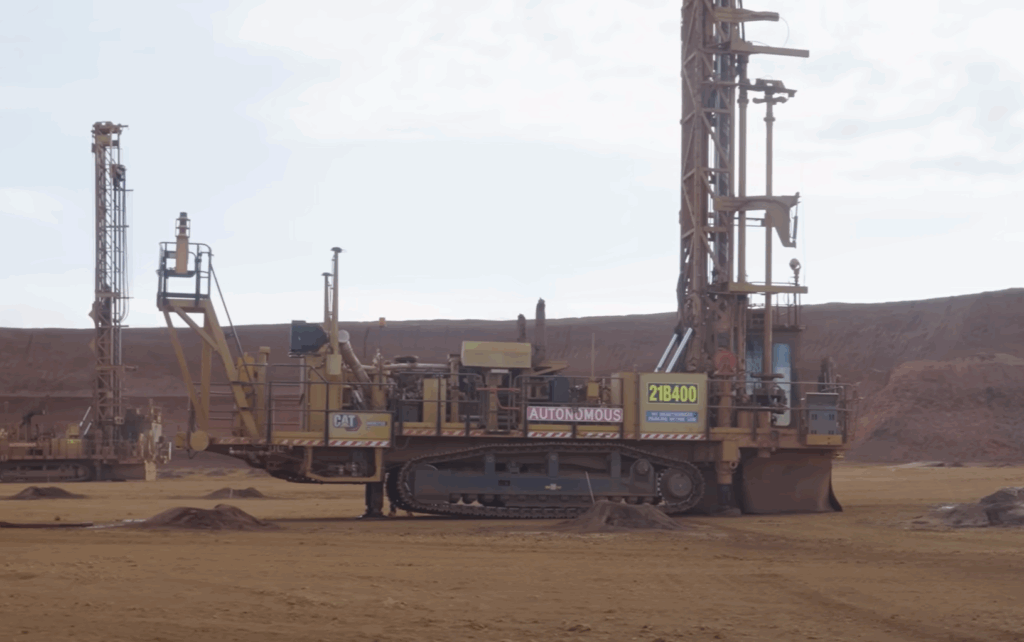
Aaron talks about autonomous equipment deployed on the Australian site and operated from a command center miles away in Perth as groundbreaking technology (It’s a pun that you would understand if you watch the video). Yes, it is impressive and I, for one understand the complexity that goes into building a product that involves both software, hardware and networking, but it’s the economics play that perplexes me.
As a trained Product Manager, and I cannot help evaluate the solution through the mindset of balancing technology needs, user needs and business objectives.
It’s not the technology that’s wrong there, they’re doing one thing absolutely correct which is decoupling the mining site with the personnel physically being present there. This is safer, probably better in terms of productivity too, and most importantly it avoids the trap of trying to make something completely autonomous, human operated remote machinery is the absolute best version of an implementation in most cases (more on that later).
But it’s the economics that perplexes me – mine site in Australia and command center in a major city of Australia itself. Tech gave you the ability to operate that machine from anywhere and benefit from a global labour cost arbitrage, and you chose to actually go to a bigger city that’s going to be more expensive?
Technological marvel – maybe, but as a business model I am not so sure.
Operation center in the developing world that has availability of trainable, English-speaking and educated workforces such as India, Vietnam, Thailand or Philippines possibly would be better from an economics standpoint, and I do believe that has to be the endgame and part of the roadmap, but for me right now this is only a proof of concept – an expensive one.
And knowing how large organisations (having spent 4 years in a Fortune 50 one) scrutinize projects w.r.t. traceable profitability, my fear is that a good idea can get discarded because of less optimal fiscal implementations. I have no way of knowing what the roadmap is.
Egos and geopolitics can play a role. If a high standing officer makes the decision to limit command centers within Australia and Perth itself, and charms his way into an emphatic declaration of love for the city/country/company roots etc. I fear a discard of the idea itself. Far-reaching thought, but look at the world around you and tell me you believe it works on rational logic?
I want to add one more thing.
I am SURE they developed this technology at a massive CAPEX too, a Valley company building for itself would have done it at a fraction of that.
Jist of the tech struggles I see as an outsider (and I could be very wrong)
Modern mining operations are critical infrastructure, but many of them are still running on 1990s-era tech and thinking. No, I am not contradicting myself, Rio before was an example of what more mining companies will need to move towards. They are not representative of the sector in general.
There are incredible engineers and operators in the space, but very few people who think like modern product builders who care about compounding improvements, user experience, or exponential innovation curves.
This means several things:
- The data infrastructure is weak. Mining companies generate massive amounts of geospatial, geological, sensor, and process data. But most of it’s unstructured, siloed, or just unused.
- The software layer is thin. The products are slow, ugly, and poorly integrated. No startup founder would tolerate this in any other industry. Worse, interoperability is buried as deep as the ore-bodies the companies are trying to extract. Contrast with the Valley – an API aggregator like Postman is a unicorn.
- The operations layer is inefficient. Mines run on rigid workflows that are hard to optimize because no one’s built flexible, intelligent systems around them.
- The design layer is non-existent. Interfaces are bad. Feedback loops are worse. Human experience isn’t considered.
There’s very little modern product DNA in this industry. Very little human-centered innovation. Excel sheets and PowerBi dashboards can only take you that far, I’m afraid.
Now, I am not making the argument that the mining people aren’t smart enough. They are, in fact they’re smarter than folks when it comes to supply chain, economics, government relations and a lot more.
Information Technology is probably one area that’s outpaced them at a speed which they keep a track of and I feel like they got a little short sighted on what technologies they needed to build upon.
Mechanical and chemical engineering were and are just as important but the next wave of efficiencies and outsized progress even in this space HAS to be Information Technology layers. I don’t see any other way.
The Worry around the evils of Tech-enablement
A fascinating example of what happens when technology is introduced to fundamentally change how an industry operates is the banking industry that went through digitization in the past few decades. A chapter I want to pull out is the Bangladesh Bank Cyber Heist where the cyber attack wasn’t even technologically sophisticated, the bank leadership and staff were just unaware of how the technology fundamentally worked. The documentary Billion Dollar Heist explores what happened, and while the plan was fascinating from a criminology point of view, the technological simplicity of the attack was baffling to me.
And that’s what I am afraid of. Mining is already a PR-negative industry. Cyber-security measures and attck counter-measures as autonomous or connected equipment comes online can have unparalleled stakes. What happens when Anonymous or god forbid The Shadow Brokers decide to take on the mining industry because in their minds, it is still a “Robber Industry” doing harm to the planet.
On a less diabolical note, I’m sure some grifters will repackage basic if-then-else statements as an “AI drone” or “AI software” and sell to these companies who don’t know IT any better, and are under pressure to adopt latest technologies will pay far more than what these technologies are worth, unless people that understand technology and can spot “wrappers” from a mile away become part of this adoption.
And almost all of them are sitting hogged up in the valley doing A/B tests on the color of the button in an ecommerce businesses checkout flow and will receive an award for an improvement of 0.69% (which still runs into billions at that scale) and are wondering about the “why” of their job.
So Why aren’t Techies joining Mining
So, mining needs (or will need) the smart tech minds, why aren’t we all switching. At this moment a thought crossed my mind and I sent Gemini on a goose chase to get me figures on how hoarder sector vs the sector in desperate need shows up as an employer.
| Seniority Level | Software Industry Average Salary (Range) | Mining Industry Average Salary (Range) |
| Entry-Level | $84,200 – $104,863 | $40,655 – $50,310 |
| Mid-Level | $109,881 – $147,524 | $58,320 – $81,192 |
| Senior-Level | $118,162 – $155,252 | $63,748 – $128,542 |
| Specialist/Engineer | N/A (covered by Senior/Lead) | $101,020 – $107,880 |
| Lead/Principal | $153,620 – $171,434 | N/A (covered by Executive) |
| Executive | $152,894 – $224,559 | $93,552 – $196,727 |
Sources: Too many of them, but I double checked figures to make sure Gemini didn’t hallucinate things; also pay data isn’t reliable in general.
The pay gap kind of explains why the Tech industry will be a magnet for people, and a hard boat for people to jump off from. I am aware of the limitations of this data but this is not a research report, it’s an opinion piece. Pitchforks back inside please.
Alright, so Tech pays way better so smarter people flow there.
Second one is the Qualitative PR issues that the sector has that I have already harped immensely in this article already.
Meanwhile, The AI Race is shaping up to be the next Space Race
A lot of people still think AI, is a hype that will die out and I confident that AI is definitely one of the technologies that will help humanity step into the next level of civilization.
Job losses are imminent and so are the new roles that will open up with the technology becoming more and more accessible.
Tech is firing on all cylinders (and governments are throwing more and more gas in the fuel tanks) to reach higher levels of compute at lower power consumption levels. While there is immense talk about the compute power of each new model, the bright lining is also the increase in algorithmic efficiency.
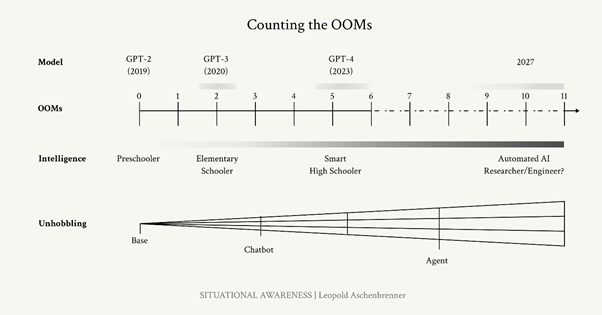
In short – we’re doing way more (compute powers measured in OOMs), but our per unit cost in terms of energy and resources is also decreasing.
What required 10 GPUs worth of power and materials 2 years ago can now be done with 1. At this rate of algorithmic efficiency, we could run our current best GPT-4 1000 times cheaper by 2027.
These numbers don’t point how impressive this picture is. If cars had advanced at this rate, a Tesla introduced 4 years ago when it was at $50K would now cost $500 and be able to travel just as fast as an actual rocket. We would have to be stupid not to harness this feat.
All of this through a model (Transformers) that was introduced in 2017, phew.
Societally & in professional life, there’s one thing I am completely convinced is a certainty and will defend with my entire might:
AI will make the Pareto Principle obsolete, and we must prepare for that world.
Past 100 years has been filled with a prevalence of nothing-jobs – economic layers that just enable the next step/function in a value chain. Levels and levels of mid-level managers whose entire job is to communicate downwards and check for mistakes from their juniors form a good chunk of that. Each level operates on their own set of tasks that fall in either the 80 or 20 bucket.
Current GPT-LLMs accessible to us shine in most people’s 80T-20I bucket, and they don’t take the 80T units of time to complete that. What that unlocks is a worker filling up their day with more of the strategic 80I-20T items.
You get a drift of what happens when this happens at a macro scale? Pace of human-learning and upskilling accelerates, job responsibilities become wider, organisations become flatter, AI creators capture value, and humans-better-than-AI purists perish. I absolutely am not saying that AI right now is better than all humans.
But ‘scaffolding’ AI into narrow agents has unlocked a level of sophistication in results that’s almost Sci-fi.
Humans workers co-piloted by AI tools is an absolute necessity to even be competitive.
And my argument is that compared against a lot of not-so-top-tier humans, this scaffolded AI agentic workflows already outperform even now. And the GPT-LLMs will keep getting better.
Not to be morbid, but KPOs (Knowledge Process Outsourcing) in India are especially the ones that are going to feel the pressure.
I am sure that I can, with the right tools, and with my current tech know-how, build an agentic workflow that can outperform most Indian KPO’s reports. TODAY.
KPOs can just hope to pivot right now, or be the technology layer that adopts this and continues to perform the same function for their existing clients at lower costs. A fantastic analysis from Leopold Aschenbrenner is saying the same thing. Here’s a snippet:
So?
Corporations in other businesses, especially in the high labour cost markets will feel the pressure first to either lay-off humans or move headcount to places like India, and parallel-ly workforces will discover better utilization and use cases for these AI tools. Especially, as more people realize how powerful the GPT-LLMs can be when paired with the right prompts. (Most people making the argument of the LLMs not being there yet for a number of tasks just haven’t figured out how to prompt well, don’t forget, you’re still talking to a robot, even if in your natural language)
All this just to say, that unlike many other fads that came in and disappeared, AI will not.
And AI’s hungry mouth will make Big Tech need to make more and more grocery runs at the mining supermarket.
Where does this bring us?
Back to the invisible hand of economics, and human hubris.
If I were to make bold guesses,
the race for AI creating unsatiated demand for more compute, coupled with green energy transition, will create more demand for materials (already happening) making the current reserves more valuable as the prices continue going up.
This should also stir up competition among the mining companies to speed up the time-to-market for the materials.
My obvious hope is that
this demand, favourable economics, and the earlier discussed threat of substitution due to technological obsoletion of the material and the mining sector already pining to be seen as more modern get stirred up. Will likely start off from the technology-forward companies first, and force the rest of the sector to also follow in order to remain competitive.
My hope is that this is enough push for the sector to embrace technology and talent that already exists in other sectors, and it rises up to meet the demand at its pace.
Because if not that, we’re preparing for a war. And it’s not a war between nations. It is a question of –
What if Silicon Valley goes to war with the mining sector?
Call me crazy, but this thought has been circling my head for months, because when I drop my conceived notion of a friendly world and one that’s still happy to be in inertia, this outcome does seem possible.
Let’s recap, we believe the AI race is going to keep Big Tech on its toes.
This is already a highly competitive sector that gets what it wants by throwing piles of money, and is the expert at getting more of it when needed and already hoards some of the smartest minds.
In order to secure what they need to continue for their hat in the ring, individual companies/consortiums will likely want a piece of the materials and capacity cordoned off for them, and/or their suppliers.
It’s hard to predict future, but if we assume the regular Valley playbooks, this is possibly how this plays out:
Friendly buyers: Tech companies try to enter exclusivity / priority contracts to secure their materials and offer above-market prices or some other niceties for a sweet deal and hope that gives them an edge over their tech sector competitors.
Deeper Partnerships: Assuming that the above hasn’t satiated the need for the materials and energy, some of the conglomerate tech companies may offer their own technical expertise in exchange for the materials and favourable deal prices. This may look like Joint Venture spin-offs for specific sites.
Direct Competition: Here’s where things turn hostile. Some companies may (driven by their management hubris) decide to enter mining themselves. It can’t-be-that-hard thought process turning into a conviction of we-can-do-it-better. May/may not be successful, but someone WILL try.
Situations 2 and 3 both may lead to a FOMO and more entry of deep tech sector interest into mining.
Smaller tech startups will try to chip off at specific monolithic value structures and try their hand at value capturing. Larger tech companies will try to vertically integrate harder to isolate themselves from supply chain shocks, fresh from the wounds of COVID related supply chain disruption.
This entire cycle will lead to more and more pressure on the incumbent mining companies, because direct or indirect competition with a more tech-adept opponent with virtually unlimited coffers is going to be way harder.
Even the biggest mining companies are likely to feel the shock. Maybe one or two could reinvent themselves and stand competitive catering to the rest of the market, but for many we might be looking at a KODAK moment. Mergers, acquisitions on the cards.
But the mining companies are behemoths, how will the bits-and-bytes even pose a threat to the atoms-and-elements? Here’s a table, that I again sent Gemini to gather.
| Tech Company | Market Cap | Mining Company | Market Cap |
| Nvidia | $4.0 Trillion USD | BHP Group | $125 – $130 Billion USD |
| Microsoft | $3.74 – $3.75 Trillion USD | Rio Tinto | $95 – $100 Billion USD |
| Apple | $3.16 Trillion USD | China Shenhua Energy | $97.70 Billion USD |
| Amazon | $2.36 Trillion USD | Southern Copper | $84 Billion USD |
| Alphabet (Google) | $2.19 Trillion USD | Zijin Mining | $69.1 Billion USD |
| Meta Platforms | $1.81 Trillion USD | Newmont | $60.78 Billion USD |
| Broadcom | $1.29 Trillion USD | Freeport-McMoRan | $55 – $60 Billion USD |
| TSMC | $1.217 Trillion USD | Agnico Eagle Mines | $60.04 Billion USD |
| Tesla | $1.04 Trillion USD | Ma’aden | $50 – $60 Billion USD |
| Oracle | $644.87 Billion USD | Glencore | $34.97 Billion USD |
So, NVIDIA alone dwarfs all of those companies even when taken together? A similar scenario is also apparent when you look at the cash reserves for these sets of companies. I’m disregarding profit, because – hah! At some point we realised shareholder value is a better metric than profit, thanks venture capital! (I’m being sarcastic, Sheldons). Anyway, at this war, cash will matter more than profits.
Now you see, if Silicon Valley did decide to go on an offensive to secure materials for what they need to unlock value, how the tables would be stacked?
Did I overthink in one direction and create a dramatic scenario unlikely to actually happen? Maybe.
But, there are early signals of Tech’s discontent at the speed/desire to control this aspect. Select few:
- Google, Amazon, Palantir, Microsoft have already in different capacities entered into partnerships with mining companies
- KoBold Metals which aims to be a new age mining company has in its investor pool Bill Gates, Sam Altman, Jeff Bezos, Mark Zuckerberg, Andreessen Horowitz
- Tesla has publicly talked about entering mining on its own, and secured some licenses
- Sam Altman has been talking a lot about Fusion reactors fulfilling private energy needs for AI. Ycombinator YouTube channel carrying coverage on Fusion Reactors. 10+ years of me following Ycombinator’s content, not once have I noticed them cover anything but tech startups and the ecosystem.
- Microsoft making a deal to acquire the power of a nuclear reactor. Also, Microsoft aiding research on Nuclear Fusion.
- (Added Later): Apple struck a deal with the only Rare Earth Miner in US MP Minerals to secure magnets for its electronics
To note, that these are only some of the public facing announcements and news bytes that I could recall from my memory. There could be many more instances of non-public information, or just newsbytes I haven’t yet come across.
What happens if Big Tech does embed itself into the mining sector. An interesting whiteboarding exercise could be to imagine what a mine/operation would look like when selected tech organisations bring their culture and missions to this space.
I plan to make that another article soon!
But what does it mean for a software engineer or a product manager today?
Or, mining is complicated, I know only bits and bytes?
But therein, lies the arbitrage for the few that dare to dream and follow their why more closely than the suitcase of printed paper (technically cotton in most countries).
Like any domain, mining has its jargon and constraints. But it’s far more welcoming than you think. There are hundreds of operators, geologists, engineers, and ESG leaders who want better tools, better data, and better systems and are actively looking for people like us.
What they lack isn’t mining knowledge. It’s modern systems thinking, product intuition, better prototyping, clean UX, creative storytelling, machine learning fluency, growth models.
You get to be early. You get to define the culture. You get to raise the bar. And you get the unfair edge that comes from seeing the truth before others do.
Mining is at a turning point. Historically, it has been manual, dangerous, environmentally damaging, and resistant to change. Most people in tech avoid it entirely.
That’s exactly why it’s ripe for disruption. And it’s woefully underserved by tech talent.
Modern mining increasingly depends on:
- Autonomous vehicles and drones for exploration and extraction
- AI/ML models for deposit prediction and resource planning
- Digital twins for site simulations
- Real-time sensors and edge computing for safety and monitoring
- Decarbonization tech to reduce environmental footprint
- ESG traceability systems for supply chain transparency
If you’re working in Tech, chances are you’re optimizing click-through rates or reducing latency in already-functioning systems.
In mining, your work could reshape entire industries, reduce planetary impact, and change how humanity accesses energy and materials.
Significant skill gaps persist, particularly in areas critical for the industry’s digital transformation:
- Data Science & AI: Essential for predictive maintenance, optimizing ore detection and sorting, identifying new mineral deposits, and real-time decision-making.
- Robotics & Automation: Crucial for autonomous equipment operation, remote control centers, and reducing human exposure to hazardous environments.
- Environmental Engineering & Sustainability: Vital for designing and implementing decarbonization strategies, advanced water management, circular economy models, and land reclamation projects.
- Cybersecurity: Increasingly important to protect AI systems and operational data from potential cyberattacks.
- Digital Transformation & Connectivity: Expertise in IoT, private 5G networks, digital twins, and cloud platforms is fundamental for integrated, data-centric operations.
- Geoscience with AI: The application of AI models to analyze geological data for improved exploration requires geoscientists with strong computational and analytical skills.
But few people who can actually build these technologies are entering the sector. That’s the opportunity. That’s the arbitrage.
My Opinion – I, The eternal Optimist and Opportunist
We confidently predict that the piles of unextracted materials are going to rise massively in value, demand expands for EVs, Solar Panels, AI services and probably every third thing launched from now will increase the demand for material and energy.
The tech manufacturing sector might make up the majority of that demand. And these companies are consuming rapidly. Apple keeps selling more iPhones, NVIDIA – GPUs, Tesla will keep setting up GigaFactories after another. Project Stargate is going to add to more pressure – I don’t want to list more examples, we can assume it’s happening.
Mining companies will feel the pressure and ticking time clock of having to be faster, leaner and more efficient as the competition for resources becomes more intense.
We’ve somewhat established that IT will likely unlock these capabilities. The demand for these tech skills HAS to go up.
Now I am not smart enough to predict when this will happen, I am someone being bombarded by stimuli and I am trying to make sense of things. To make sense to my brain, and to my heart.
My only goal in life at the moment is to wake up excited about what I did, and what I can do next.
This is what my heart tells me – most of what Silicon Valley builds today is derivative. Optimizing social graphs, improving ad targeting, automating paperwork. You didn’t learn to design, code, think, or tell stories just to sell people more junk slightly faster. You learned those skills to build. To explore. To push the edges of what’s possible.
Silicon Valley taught us how to think big. But now it’s running in circles. Optimizing clicks. Automating mediocrity. “Disruption” has become code for “slightly more convenient.” And we’re here, building dopamine loops for teenagers on TikTok and elders on Facebook.
Mining is one of the last big, unsolved, essential industries. It’s upstream of civilization. It’s full of complexity and consequence.
What’s more inspiring: Making the 43rd TikTok clone or changing how humanity extracts the elements of progress?
Even if I don’t get to build, influencing is good enough at the juncture humanity is right now.
Every major trend starts as a contrarian bet.
- Software was dismissed as a niche until it ran the world.
- Electric vehicles were toys until Tesla made them aspirational.
- AI was overhyped in research labs until it broke into consumer scale.
Today, mining feels like yesterday’s problem. Dirty. Slow. Bureaucratic. That’s exactly why it’s tomorrow’s biggest opportunity.
The minute mainstream capital, talent, and media flood into a domain, the outsized returns are gone. The smartest builders seek asymmetric bets. Mining is one of them. Today, mining might seem unsexy, but it won’t be for long.
I am reminded of a quote–
The future is uncontrollable, but you can shape your participation in it.”
Roger Martin
But Mining sector has a lot of Inertia, can tech really move a mountain?
My argument is that it is not a choice. Whether by evolution or force, it will need to modernize. Think about it, we live in fascinating times where science fiction is turning into non-fiction.
The Crazies at CERN made Alchemy a reality: An experiment at CERN recently announced that they had been successful at converting lead atoms into gold atoms by knocking off a proton using the Large Hadron Collider. The resulting Gold atom only survived for a fraction of a second, but for that fraction of a second, alchemy was real.
The US Navy has a working Death Laser that gives me nightmares: The US Navy’s HELIOS (High Energy Laser with Integrated Optical Dazzler and Surveillance) is a 60+ kW laser weapon system developed by Lockheed Martin and integrated with the Aegis combat system has already been integrated into a warship and deployed
Microsoft invented a new state of matter, but still can’t fix Outlook: Microsoft in its research for building Quantum Computing chips called Majorana 1 claimed to have invented a new state of matter and called it their chip a Topoconductor.
Braincell Chips have been made into a reality because Artificial Intelligence is creepy: Australian startup called Cortical Labs trained a network of lab-grown human neurons fused onto a silicon chip to play Pong via real-time feedback. Biological intelligence and silicon logic are no longer separate domains. We are literally wiring thought into matter. Also, flipped script – Neuralink, ugh
Thorium based Nuclear power batteries are on the horizon. Private Space Industry exists and we’re only years away from commercial space tourism
If nothing else, the fascinating story of Demis Hassabis, a neuroscientist-turned-game-developer-turned-AI-founder, whose company DeepMind solved the 50-year-old problem of protein folding with AlphaFold, an AI trained not by biologists, but by coders and mathematicians. Demis was just awarded the NOBEL Prize in 2024! Someone with no formal training in either chemistry, biology or medicine winning the most important prize on the planet. (PLEASE WATCH THIS DOCUMENTARY)
There’s no escaping progress. And mining will not be immune to the change.
How to bring about the change?
Tough topic, but I feel like mining and energy in particular has been dealt the wrong end of the stick. As someone who stood in tech and retail decision rooms and tried to both successfully and unsuccessfully influence change, I can tell you that it’s about persuasion, business logic, and psychological shift.
I’ve learned that convincing experienced, powerful people to rethink their default instincts isn’t just about a number’s game, it’s an equation game of more variables than is visible at first glance.
I want to explain with an example.
Here’s another Youtube Video I came across. It describes a company called Terraform. They’ve built a machine that uses solar energy to capture carbon from the air and convert it into methane. It’s only about 35% energy-efficient. But here’s the kicker: the methane it produces is compatible with existing infrastructure. And when you compare its cost-benefit ratio against drilling new wells, the math starts to work.
Now, they may be selling complete snake oil about what their machine can do. But their logic – economically, industrially, environmentally makes more sense than doubling down on rigs. Sure, the tech might be scrappy. The inefficiency is good enough at the cost. They could make a machine that’s more efficient, but that would cost a lot more too. This is the kind of framing that wins minds. Not the shouting.
Now contrast this to this YouTube video where Al Gore makes emphatic declarations about climate change and derides everyone who’s disagrees with him. I used to be impressed by these things once upon a time, but now all I can think is that the guy sounds like a petulant teenager who has never been told NO in their life. All of the activists shouting “Stop Oil” or “Go Vegan” are not really contributing to solving anything. Shaming isn’t a strategy that can win.
But Business Economics can.
You want the industry to adopt greener technologies, let’s make them cheaper/safer to adopt.
Not everything can be made cheaper, what else can make it more attractive? Lobbying? Carbon Credit Systems? Green Marketing and Clean Labels allowing for product to command higher prices than regular commodities? There’s way more that can be influenced through economics than activism.
DeBeers made worthless diamonds into an expensive object of desire, we all pay more for certified organic produce than regular produce. Marketing-Psychology-Economics paired together is a powerful needle-mover.
You show them a positive parity in what we spend vs what we reap – they are interested. Because when you show mining leaders that greener can be richer, that sustainability can be a strategic advantage, or technology will save costs / make more money, they will they start to pay attention.
In Al Gore’s own words – “It’s difficult to get a man to understand something if his income depends on him not understanding it.” I say – so let’s make it!
